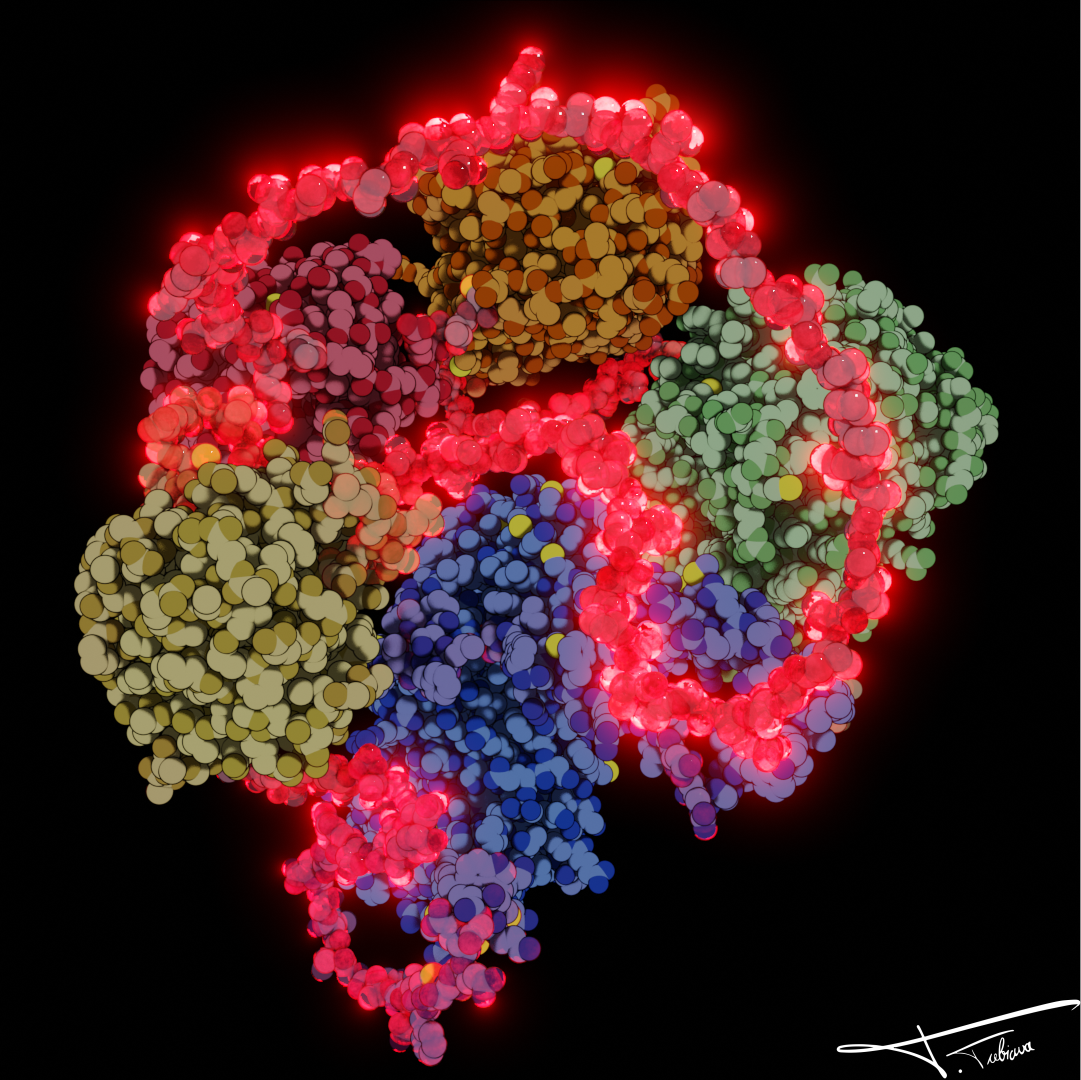
AlphaFold-based modelling revised the domain map of HEV's replication polyprotein ORF1 — five domains, not six, and no protease domain.
HEV’s replication polyprotein ORF1 (pORF1, ~1700 residues, 186 kDa) carries the viral RNA polymerase and is essential to replication, but its size, multi-domain architecture and membrane-associated regions make it very hard to produce with standard expression systems — which had long kept it out of reach of structural biology.
Working from a soluble form of pORF1 that Dr. Sonia Fieulaine developed using an atypical cell-free expression system, and combining cryo-EM with AlphaFold-based modelling, I revised the domain map first proposed by Koonin in 1992. Rather than the six domains and canonical protease originally proposed, the models show five domains organized into two modules separated by a hypervariable region — and no protease domain at all: the region long annotated as a papain-like protease is in fact a fatty-acid-binding-domain (FABD)-like fold. The N-terminal Met and Y domains, previously described separately, are better understood as a single domain I named MetY, homologous to the alphavirus protein nsP1.
I’m now extending this domain classification across HEV genotypes and host species, to help clarify the zoonotic risk of animal-to-human transmission and settle the long-running debate over a putative ORF1 protease.
MetY’s homology to nsP1 also suggested it might oligomerize into a membrane-binding pore — a hypothesis I’m testing computationally with Dr. Chantal Prévost (IBPC), alongside preliminary experimental evidence of membrane interaction from Dr. Sonia Fieulaine, with Gabriel Vanegas Arias (PhD student I co-supervise) now extending this work. The ORF1 viewer lets you explore these AlphaFold models across HEV species and genotypes interactively.
Dr. Stéphane Bressanelli (I2BC) · Dr. Sonia Fieulaine (I2BC) · Dr. Chantal Prévost (IBPC) · Dr. Sandhya Tiwari (Osaka University) · Dr. André Gömer (Ruhr University Bochum)