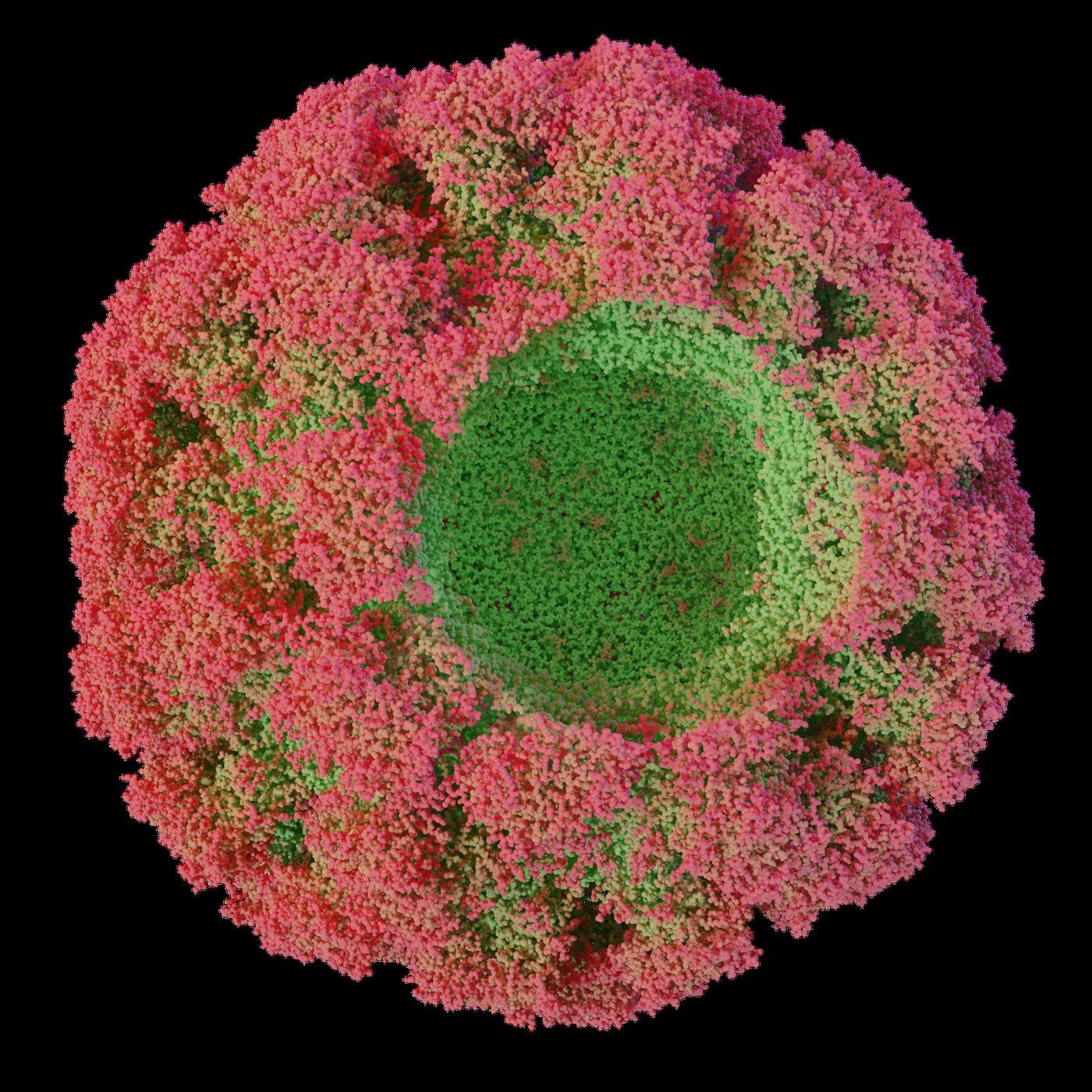
From a single VP1 dimer to a full icosahedral capsid: PhD work combining modelling, SAXS and cryo-EM to understand how norovirus capsids grow.
Norovirus causes acute gastroenteritis and is built from 90 dimers of a single structural protein, VP1. My PhD asked how that capsid actually assembles.
Modelling the VP1 dimer for both a human strain (with a known capsid structure) and a bovine strain (with only SAXS data), I found that the dimer adopts a markedly different conformation free in solution versus assembled in the capsid — validated experimentally by SAXS. Working with normal-mode analysis and coarse-grained (MARTINI) simulations of the proposed pentamer-of-dimers assembly intermediate, together with Jean-Charles Carvaillo (whom I co-supervised), we then used a growth protocol combining protein-protein docking with molecular dynamics to show that capsid growth from this intermediate is anisotropic — contradicting the isotropic growth model originally proposed alongside the 1999 capsid structure. Separately, using cryo-EM maps from Dr. Jean Lepault, I modelled the capsid of a bovine genogroup (GIII.2) by flexible fitting, revealing that its spicule domain is more conformationally flexible than the human strain’s.
Along the way I wrote TTClust, a molecular-dynamics trajectory clustering tool built to make sense of these simulations — now one of the most widely used pieces of software I’ve released.
Dr. Stéphane Bressanelli (I2BC) · Dr. Yves Boulard (I2BC) · Dr. Jean Lepault (I2BC)